Showing posts with label religion. Show all posts

02 January 2009

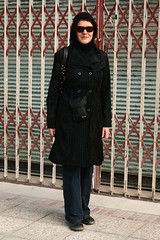
Tourist hejab

During the early part of our trip, in Tehran and then Gilan province, we saw not a single non-Iranian tourist. In Esfahan we spotted a handful (mostly Asians, interestingly enough) and then more and more as time went on. Must have been something to do with our timing.

I was struck by how a minority of female tourists just didn't seem to understand hejab (mandated modest clothing), or else got it but chose to try to push it to the legal limit.

Stripping away all the baggage that hejab carries and avoiding any discussion of the rightness or wrongness of it, acceptable hejab in Iran boils down to a few really simple rules:
  • It's the law in Iran.
  • It applies to men and women, but not equally. For blokes, the only restrictions are no t-shirts and no shorts.
  • Women have to cover their hair. A bit of fringe is OK.
  • Women have to cover their bums with a long top or jacket, at least mid-thigh length.
  • You can take off your coverings in your own private space.
That's it. I was really surprised to see tour groups of mature adults (probably thoughtful and intelligent adults) wandering about as though they were in a European city. It dawned on me that either they just weren't looking around them to see how Iranis dressed, or had chosen to attempt to buck the system. Equally, I was surprised that the tour guides didn't pull them up on it. (Maybe they were too polite?)

I reckon the sloppy tourist dress really caught my eye because Aisling adopted hejab with as much style as possible (well, I would say that, wouldn't I?), copying the type of hejab worn by educated urban Irani women. She blended in really well; quite a few times I had to search for her in bazaars if her back was turned, because her veil and manteau (long overcoat) looked so much the part.

The thing about hejab is that although it's mandated by law in Iran, most Iranians will respect you for adopting hejab just like everyone else. Aisling was only ever treated with the greatest of courtesy; she wasn't subjected to leering, groping or inappropriate comments, even on the few occasions when she went wandering around the bazaars by herself. I have a suspicion that some of the tour group folks wouldn't have had the same mellow experience of Iran that Aisling did.

If you're resentful of the oppressive dess code, wouldn't you feel all the more annoyed if a local pulled you up because your dress wasn't modest enough? Better to treat it as Aisling did, as a necessary fancy dress, do it with as much style as possible.

01 January 2009

"Givaneh!"

It's the month of Muharram in Iran and black-clad male Shia adherents are parading in the streets in preparation for the day of Ashura, which is the day on which the Shia saint Husayn was slain by troops of the Sunni Caliphate at the Battle of Karbala 1,329 years ago.

The anniversary is treated as a period of mourning; for weeks in advance, on bus journeys, we've been hearing monotone chants for hours on end grieving the loss of Imam Husayn. The event is covered on television as though Husayn was killed yesterday. Mullahs weep openly in television studios. Hours of programming are given over to the event.

A parade of several hundred men walked past our hotel in Shiraz yesterday. I went out onto the street to watch them. A lone drummer beat out a slow rhythm on a huge bass drum while the men chanted a monotone dirge. They each wielded a whip, made from several short lengths of chain attached to a wooden handle, ceremonially striking themselves over the shoulder and onto their backs in time to the drum. It was more a stroking, not a lashing. (It's no longer considered appropriate to break the skin.)

It was dark, but I stood on a raised grassy median strip in the middle of the busy road and tried to take some snaps in the available light. A man about my own age approached me. "Where are you from?" he asked. "Ireland," I replied. "Man Irlandiam."

"Givenah," he said scornfully. "They are foolish."

Mohammad Reza in Jolfa, Esfahan

This is Mohammad Reza, enjoying food and conversation with us in the old Armenian quarter of Esfahan. Dinner with random strangers? Only in Iran could you contemplate such a thing.

We were standing on a street corner in Jolfa in the dark, looking in the guide book for a restaurant that wasn't there anymore. I was wearing my tourist beacon. Mohammad Reza approached us and asked did we need help. We got into the usual introductory chat ("Where are you from, what do you do?") and after we'd wandered around for a bit and consulted the map several times, he confirmed that the restaurant we were looking for was definitely closed.

We asked him to suggest another restaurant to us and invited him to join us for some food. After protestations, he politely took us up on our offer.

Mohammad Reza is a material sciences student, studying in Esfahan but also a native of the city. He'd spend a year living in Vancouver when he was fifteen (his dad is a university professor) and going to school there. He'd loved it. He's 22 now and almost finished his course. We'd learned all this before we'd even found the restaurant. His English is excellent and he's a funny guy with a quirky sense of humour.

We had a great evening chatting about all kinds of subjects; towards the end of the evening, Mohammad told us how, as a rational fellow, he'd weighed up the evidence for and against God and had decided that Islam was the religion for him. Yes, he admitted, he was born into a Muslim family, but on balance he reckoned it was the religion with the best moral code.

He explained that Muslims don't believe in the Christian notion of the Trinity or in the divinity of Jesus ("There no God but Allah and Mohammad is his prophet") and when we got onto the topic of heaven and hell, I asked about the fate of unbelievers.

"Well," he said with a grin, "there are good Muslims who go to heaven and there are bad Muslims who go to hell. If you're born a Muslim, it's impossible to be unbeliever!"

27 December 2008

Zoroastrian pilgrimage site, Chak Chak, Yazd province, Iran

We hired a driver today to bring us around some spectacular historical sites around the desert city of Yazd. One of these is Chak Chak which is a Zoroastrian pilgrimage site.

To get here, we drove across a moonscape of craggy mountains which you can see in the distance here. The site is the source of a clear mountain spring and a tree reputed to be a thousand years old. There is one caretaker who lives here alone all year apart for the time of the Zoroastrian festival when the place is thronged with thousands of worshipers.

This is a view from inside the temple which we had to ourselves. It was completely peaceful and silent and made a lovely change to the noisy city sounds.